

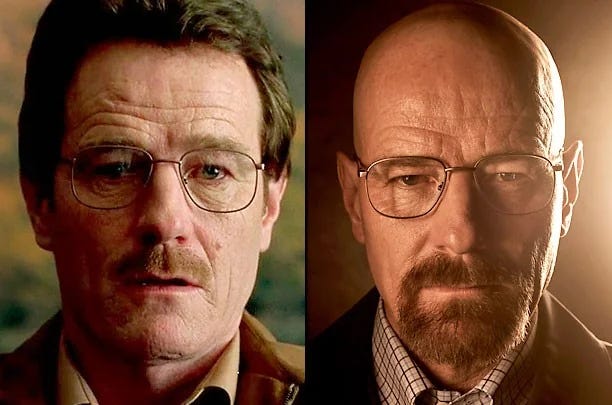
“Breaking Bad” S1:E3 (“…And the Bag’s in the River) opens with a scene from Walt’s earlier life. He’s younger, with a beard and slicked-back hair, and he’s working through a chemistry problem with a young woman. They attempt to identify the composition of a human being and end up with a minute percentage of unexplained chemical makeup. Walt is perplexed that something is missing—there’s got to be more to the human person than the elements they have put on the board. This scene raises a crucial question. What does it mean to be human? And how do we know when we’ve lost that mysterious something else—the thing that makes us human?
This opening scene is spliced into frames of Walt and Jesse cleaning up the mess from Jesse’s attempt to chemically “disincorporate” Emilio’s body in a bathtub instead of the container Walt specified. Cleaning up this chemically disincorporated body reminded Walt of his youthful query about the meaning of being human—or at least into the makeup of humanity. As Walt cleans up Emilio’s remains, surely he is wondering what happened to that undiscovered element—the part that might not be able to be cleaned up.
However, the most captivating scene is when Walt interacts with Kraze 8. Walt was responsible to kill Kraze 8 because, in an earlier episode, Jesse and Walt flipped a coin to see who would disincorporate Emilio and who would kill Kraze 8. Jesse commented that the coin flip was sacred; Walt’s sacred duty was to execute Kraze 8. So, when Walt engages with Kraze 8, the scene is given a sacred framework from the outset.
This sacred framework introduces a Eucharistic scene. Karze 8 calls up for a meal. Walter obliges and makes a sandwich, exercising consideration by cutting off the crust. Walt’s first attempt to serve the sandwich was cut short when he passed out while coughing. When he came to later, Kraze 8 commented on the incident. For the first time, Walt confessed that he had lung cancer. At that moment, Kraze 8 became a priest, hearing a confession that Walt had dared to give to no one–not even his family.
Although his initial attempt to serve the sandwich is thwarted because he passed out during a coughing fit, he cleans up the broken plate and sandwich and makes a new one to serve to Kraze 8. This time, he also grabs a six-pack of beer to take down so that they can drink while breaking bread. Walt even assures Kraze 8 that the sandwich is not poisoned and offers it in good faith. As their conversation unfolds, Walt asks Kraze 8 to sell him on not executing him. Walt doesn’t want to kill Kraze 8 and is looking for an excuse not to.
In this intimate setting, Walter asks Kraze 8 for his real name. He wants to know him, to really connect. Kraze 8’s name is Domingo, which Walter points out means “Sunday” in English. Domingo agrees but notes that he’s never liked his name. At this point, the Eucharistic imagery is undeniable. Sunday (the day of the Resurrection and the day on which Christians across the world celebrate the Eucharist) and Walt share beer (replacing the wine) and a sandwich (standing in for the bread) as they commune with one another. They genuinely connect, particularly over Walt’s purchase of a crib (maybe an allusion to Jesus’ presentation as food for the world in the manger?) sixteen years ago at Domingo’s father’s furniture store (along with the extended warranty, which occasions a laugh from both of them).
This act of communion convinces Walt not to kill Domingo. The camera angle is striking when he goes upstairs to get the key to unlock the bike lock that has captivated Domingo to the beam in the basement. The camera looks down from above, giving viewers a distinct vantage point. It is as if Walt is reaching up to heaven for the key so that what is loosed in the basement will be loosed in heaven. Although Walt doesn’t know it, he is living into his humanity as he recognizes Domingo’s humanity. This realization takes place in the sacramental meal that binds humanity together, uniting them in that unidentifiable element of the human person referenced in the opening scene.
On the way down, Walt crushes his beer can and throws it into the trash. But it dawns on him that something isn’t quite right with the plate in the trash. Here, and throughout the series, Walt has surprising intuition. He pieces together the broken plate. One jagged piece is missing. Walt begins crying, “No,” and “Don’t do this,” searching the trash again, hoping against hope that Domingo did not betray him. But Domingo is a betrayer. Sunday is a Judas.
In one of the most gripping scenes in the show so far, Walt asks Domingo to turn around so that he can unlock the bike lock and release him. But as he does, Domingo begins to reach for the plate, and Walt asks if Domingo plans to kill him with the plate. As soon as Walt asks the question, Domingo grabs the plate fragment and begins swinging at Walt. Walt pulls back on the bike lock, choking Domingo. He then uses his leg as a reinforcement against the post and is stabbed in the leg, but ultimately kills Domingo. They both fall to the floor, with Walt crying that he is sorry.
In a later scene, Walt sits in his car, and a flashback is spliced into the moment. There, the woman from the opening scene working on the chemical makeup of the human person suggests that the missing element is the soul. This observation raises the question, “Has Walt lost his soul by taking Domingo’s life?”
In this scene, Domingo is painted as a Judas, but Walt is no Christ figure. Jesus embraced his betrayal while Walt dominated his betrayer. Jesus gave up his life in order to gain it. Walt saved his life, perhaps at the cost of his soul.
It’s difficult to say that there is a turning point when Walt breaks bad—when he sells his soul to the devil, just as it is challenging to identify a particular moment of conversion or redemption for other characters (especially Jesse). However, this scene, in which the Eucharist is inverted, makes the viewer wonder if Walt has truly broken bad from the start. His first killing was a killing of desperation. But this killing took place in a controlled environment and against a weak (though also despicable) victim. At the same time, Domingo’s bad faith in breaking bread with Walt makes the killing all the more justifiable, at least from a certain vantage point. If, in the intimacy of a meal echoing the Eucharist, Domingo cannot be trusted, he surely will make life hell for Walt if he gains his freedom.
The profound questions about what it means to be human that frame the entire episode shed light on how Walt progressively loses his humanity. Walt got into the drug business to provide modestly for his family. He had no interest in cancer treatments. He had no desire to save his own life or to become wealthy. But as the series progresses, it becomes evident that Walt’s priorities shift through the corruption of money and power. And, as they shift, Walt becomes less human, losing his soul.